
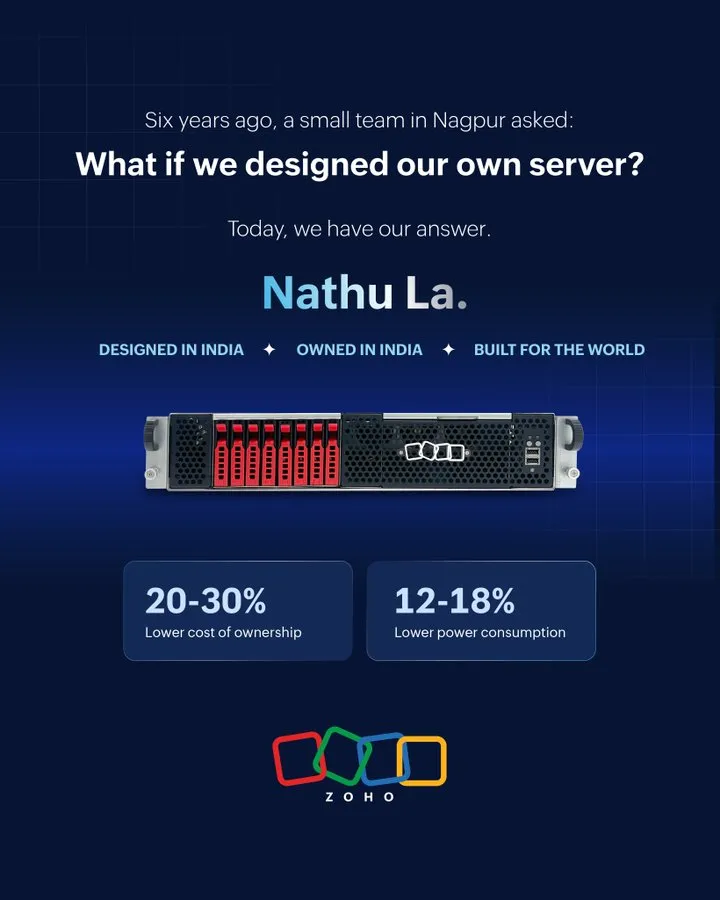
Indian SaaS giant Zoho has officially stepped into the hardware industry with the launch of Nathu La, a server platform designed and developed in India. The move marks a significant milestone for the company as it seeks to reduce rising infrastructure costs driven by artificial intelligence workloads while strengthening technological self-reliance.
Why Zoho Built Its Own Server
As AI adoption accelerates globally, companies are facing rapidly increasing expenses related to computing infrastructure, cloud operations, and AI inference workloads. Instead of relying entirely on external server manufacturers, Zoho has chosen to design its own hardware stack to gain greater control over performance, efficiency, and costs.
The new server platform, named Nathu La, has reportedly been under development for several years and is being deployed across Zoho’s global data centre network. According to the company, the platform delivers performance comparable to existing enterprise servers while consuming significantly less power.
Lower Power Consumption and Reduced Ownership Costs
One of the biggest advantages claimed by Zoho is improved operational efficiency.
The company says Nathu La can achieve:
- 12–18% lower power consumption
- 20–30% lower total cost of ownership (TCO)
- Reduced AI inference costs
- Better optimization for Zoho’s own software workloads
With data centres becoming increasingly expensive to operate due to AI-driven demand, these savings could translate into substantial long-term cost reductions.
Built in India, Developed in Nagpur
The server platform was developed by Zoho’s hardware engineering team based in Nagpur. The company has emphasized that local talent played a major role in the project, aligning with its long-standing philosophy of nurturing engineering capabilities beyond India’s traditional technology hubs.
Nathu La uses Intel Xeon 6 processors and was developed in collaboration with Intel to ensure enterprise-grade performance and reliability.
Not for Sale Yet
Unlike established server manufacturers such as Dell, HPE, and Lenovo, Zoho is currently not planning to sell Nathu La commercially. Instead, the company is using the platform internally across its own infrastructure.
Zoho has already deployed several hundred units and plans to significantly increase deployments over the coming months as it validates performance across different workloads.
A Long-Term Vision for Technological Sovereignty
Zoho’s hardware initiative is not entirely new. The company had previously indicated plans to develop its own server technologies to reduce dependency on external vendors and lower operational costs. The launch of Nathu La represents the realization of that strategy.
The move also aligns with broader efforts to strengthen India’s capabilities in critical technology infrastructure, including cloud computing, AI, semiconductors, and data centres. As demand for sovereign and locally controlled digital infrastructure grows, initiatives like Nathu La could become increasingly important.
What This Means for the Industry
Zoho’s entry into hardware is notable because few software companies develop their own server platforms. By controlling both software and infrastructure, Zoho can potentially optimize performance, improve efficiency, and reduce costs across its ecosystem.
As AI workloads continue to expand, more technology companies may explore vertically integrated approaches similar to those adopted by major global hyperscalers. Zoho’s Nathu La could be an early example of how Indian technology firms are preparing for that future.
Conclusion
With the launch of Nathu La, Zoho has moved beyond software and into core computing infrastructure. The India-designed server platform aims to lower power consumption, reduce AI-related expenses, and strengthen the company’s technological independence. While currently intended for internal deployment, the initiative highlights India’s growing capabilities in advanced hardware engineering and data centre technologies.