
KPMG survey shows Canadian organizations are rapidly adopting AI agents as they plan for a workforce that fully integrates humans and AI
TORONTO, May 6, 2026 /CNW/ – Canadian business leaders are planning for a future workforce made up of humans and AI agents. New KPMG Canada research shows organizations are increasingly adopting agentic AI systems, marking a notable shift in how businesses operate, hire talent and manage employees.

KPMG surveyed 306 executives at Canadian companies on how AI is being used in their organizations. The research found that while AI is a top investment priority overall, agentic AI–which operates independently with minimal human oversight–is a key part of their strategy to drive operational efficiency. More than three-quarters (77 per cent) are already using agents to assist with tasks such as knowledge sharing between departments, and two-thirds (66 per cent) are moving towards a fully integrated AI-human workforce where humans work alongside agents.
“As organizations move quickly to scale AI agents, we’re seeing a generational shift in how work gets done. Business leaders are starting to design roles, teams and workflows on the assumption that humans and agents will work together, with agents taking on work such as research and coordination, and people focusing on judgement, decision-making and accountability,” says Stephanie Terrill, Canadian Managing Partner of Digital and Transformation, KPMG Canada. “This change has implications for everything from operating models to governance and risk management, as well as commercial and workforce planning considerations. The organizations making progress are the ones treating agents as more than productivity tools and actively reshaping how work is structured.”
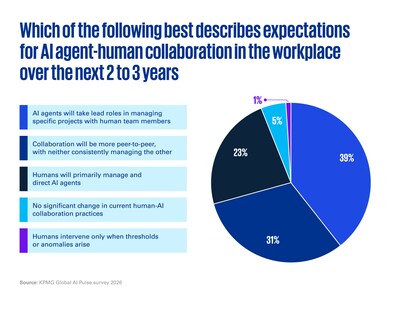
More than half of Canadian survey respondents (59 per cent) say AI agents have already changed the way their organizations hire entry-level workers, while 63 per cent say the same about experienced talent. Respondents also expect agents will have an impact on the employee evaluation process. Anticipated changes include having AI collaboration competencies built into performance reviews and role requirements (39 per cent), more emphasis put on human capabilities (i.e., critical thinking, contextual awareness, etc.) over tasks now handled by AI (39 per cent) and redefined promotion criteria that prioritizes AI literacy and effective agent delegation (36 per cent). Business leaders also predict that in the next two to three years agents will either be leading project management for teams (39 per cent) or working alongside humans as peers to complete tasks (31 per cent).
With more than half (52 per cent) of respondents saying they expect AI to match human level reasoning in the next three to five years, organizations are increasingly emphasizing creative thinking (46 per cent), problem-solving skills (44 per cent) and adaptability (43 per cent) when hiring entry-level talent.
“We’re moving into a phase where AI isn’t just supporting work in the background but is now actively shaping how organizations think about talent. That’s changing the way employers assess people, with more weight being placed on how individuals apply judgment, think critically and operate in environments where AI is embedded into day-to-day work,” says Lewis Curley, a Partner in the People and Change practice at KPMG Canada. “At the same time, it reinforces the importance of human skills. According to our survey data, 65 per cent of business leaders say social and interpersonal capabilities now matter more than technical expertise, which highlights that success will come from how effectively people combine those strengths with AI.”
Canadian businesses struggling with ROI more than their global counterparts
While 70 per cent of Canadian organizations say AI is delivering meaningful business value, only three per cent have achieved measurable returns on their AI investments. The primary obstacle respondents identified is a workforce skills gap. Globally, eight per cent of respondents have successfully realized a return on their AI investments.
Another hurdle business leaders are facing is uneven adoption of agentic AI in the workplace. In Canada, 31 per cent of employees show resistance to the technology, compared to 16 per cent globally. Over half (51 per cent) say trust and ethical concerns are to blame for employee hesitation, and nearly 40 per cent say it’s due to job security worries or a lack of confidence in their AI skills and capabilities.
To close the gap, Mr. Curley says businesses need to do more than simply train employees to work with AI agents, they also need to be deliberate about how human-AI collaboration will drive value at their organization.
“When organizations are looking at upskilling their workforce, they must have a clear picture of how their people can use AI agents in ways that deliver meaningful impact on the business,” says Mr. Curley. “A skilled employee can build an agent to automate tasks and get work done faster, but if it’s not being used on work that produces results, companies won’t see the returns they’re looking for.”
As they prepare employees for a new way of working, leading organizations are establishing clear protocols for when and how to use AI agents. Other top actions include creating sandbox environments where employees can practice interacting with the tools and developing role-specific guidelines for effective collaboration and delegation.
“The technology isn’t the problem, it’s whether the workforce is equipped and confident enough to use it effectively. When people don’t understand how to work alongside these tools or don’t trust them, adoption stalls, and so does the return on investment,” says Mr. Curley. “Agentic AI is changing how we work, and in this new environment all employees become managers, responsible for overseeing and delegating work to agents. The organizations getting ahead are investing just as much in developing their workforce’s management abilities as in their AI literacy skills. Everyone now needs to know how to allocate work, assess quality and give effective feedback, because that’s what ultimately unlocks value.”
About the survey
KPMG International’s Global AI Pulse is a quarterly global study capturing the perspectives from 2,110 C-suite and business leaders representing organizations in 20 countries, territories and jurisdictions. The research was conducted between February 19 and March 27, 2026. Of the 306 Canadian respondents, 28 per cent reported annual revenues of $50 million to $99 million; 28 per cent reported revenues of $100 million to $499 million; 20 per cent reported revenues of $500 million to $999 million; 12 per cent reported revenues of $1 billion to $4.9 billion; eight per cent reported revenues of $5 billion to $19.9 billion and five per cent reported revenues of $20 billion or more.
About KPMG Canada
KPMG LLP, a limited liability partnership, is a full-service Audit, Tax and Advisory firm owned and operated by Canadians. For over 150 years, our professionals have provided consulting, accounting, auditing, and tax services to Canadians, inspiring confidence, empowering change, and driving innovation. Guided by our core values of Integrity, Excellence, Courage, Together, For Better, KPMG employs more than 10,000 people in over 40 locations across Canada, serving private- and public-sector clients. KPMG is consistently ranked one of Canada’s top employers and one of the best places to work in the country.
The firm is established under the laws of Ontario and is a member of KPMG’s global organization of independent member firms affiliated with KPMG International, a private English company limited by guarantee. Each KPMG firm is a legally distinct and separate entity and describes itself as such. For more information, see kpmg.com/ca.
For media inquiries:
Alannah Page
National Communications and Media Relations
KPMG Canada
(306) 934-6255
[email protected]
SOURCE KPMG LLP
